News
Our products are exported to over 30 countries.
Possess the full-process development capability from concept design to mass production and implementation

Possess the full-process development capability from concept design to mass production and implementation
Analysis of UV LED Curing Machines for Production Lines: Features and Applications of Tunnel-Type UV Curing Ovens
In modern industrial manufacturing, UV LED curing technology has become a key factor in production line upgrades across numerous industries due to its efficiency, energy savings, and environmental benefits. Among these, conveyor-based UV LED curing machines—particularly tunnel-type UV curing ovens—serve as core equipment for achieving continuous, batch production. This article will delve into their working principles, key features, and extensive applications, while providing practical selection guidelines.
What is a Conveyor-Type UV LED Curing Machine?
A conveyor-type UV LED curing machine, typically referring to a tunnel UV curing oven or belt-type UV LED curing machine, is a curing device designed for seamless integration with production lines. It positions workpieces requiring curing on a conveyor belt moving at a constant speed, guiding them smoothly through an irradiation zone equipped with specific wavelength UV LED light sources. This enables rapid curing of UV adhesives, inks, varnishes, or epoxy resins on substrate surfaces within seconds, significantly boosting production efficiency.
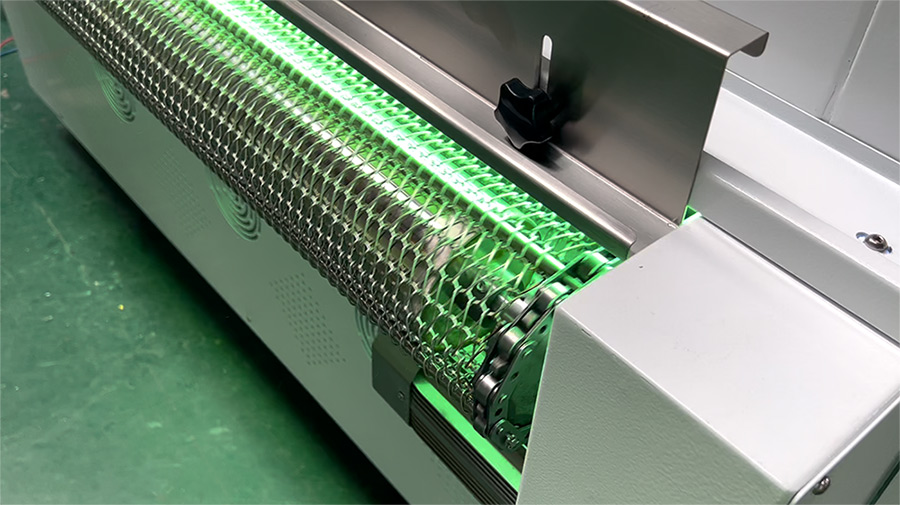
Key Features of Tunnel-Type UV Curing Ovens
1.Simple and Efficient Operation
Equipment typically comes with an intelligent touchscreen controller, allowing users to directly set conveyor belt speed, light intensity, and exposure time. This “simplified” interface reduces operational complexity and training costs.
2.Stable and Reliable Performance
Core components are independently developed and undergo rigorous aging and performance testing before shipment. This ensures consistent light output and reliability during prolonged continuous operation, guaranteeing uniform production quality.
3.Seamless Integration into Production Lines
Designed for automated production lines, the equipment can be customized to align with workshop layouts and production rhythms. This not only optimizes workflow and reduces labor and space costs but also enables efficient, continuous operations from coating to curing.
Wide Range of Applications
UV LED tunnel curing ovens are suitable for applications demanding high curing speed and quality:
Optics and Optical Communications: Lens bonding, fiber coating curing.
Medical Devices: Assembly of disposable items, bonding of medical catheters.
Electronic Components: Chip packaging, conformal coating of circuit boards, component fixation.
Semiconductor Materials: Temporary bonding and debonding.
Other Industries: Label printing, plastic part coating, craft encapsulation.
How to Customize a Suitable UV LED Tunnel Curing Oven?
Customizing the right equipment is key to successful application. Focus on the following points:
Confirm the curing material's spectral requirements: Different UV materials (adhesives, inks) have their optimal absorption wavelengths. Verify the required peak wavelength of UV light (e.g., 365nm, 385nm, 395nm, or 405nm) with both the material supplier and equipment customer service to ensure spectral compatibility.
Determine the required energy: The UV light energy needed for curing (typically measured in mJ/cm² or J/cm²) directly impacts curing depth and completeness. Calculate the required light intensity based on material technical specifications to meet production line speed requirements.
Evaluate production line parameters: Provide the conveyor belt's effective working width, height clearance restrictions, desired conveying speed, and daily output to design appropriate equipment dimensions and power.
Consult professional manufacturers: Select manufacturers like Futanxi with independent R&D capabilities. They can provide testing and customized solutions tailored to your specific process, effectively avoiding issues like incomplete curing or rework caused by wavelength or energy mismatches. This ensures a one-time investment for long-term, stable production.
19 years of focus on research and development as well as production