News
Our products are exported to over 30 countries.
Possess the full-process development capability from concept design to mass production and implementation

Possess the full-process development capability from concept design to mass production and implementation
In the production of electronic components, food processing, chemical materials, lithium batteries, pharmaceutical raw materials and other industries, the vacuum nitrogen-filled oven is a core anti-oxidation drying equipment. The stability of its nitrogen concentration directly determines the material quality. Once the nitrogen concentration is insufficient, it is very easy to cause material oxidation and deterioration, discoloration, and performance degradation, which not only affects production efficiency, but also causes raw material waste and increased production costs.
Aiming at the common pain point of "insufficient nitrogen concentration" for users of industrial ovens and vacuum nitrogen-filled ovens, this article provides systematic troubleshooting steps, practical solutions, and daily maintenance skills to help enterprises quickly solve problems, stabilize the nitrogen protection process, and avoid production losses. (Adapting to Baidu search core needs: What to do if the nitrogen concentration of the vacuum nitrogen-filled oven is insufficient, the reasons for insufficient nitrogen concentration of the industrial oven, and the troubleshooting of vacuum oven seal leakage)
To solve the problem of insufficient nitrogen concentration, the key is to identify the root cause. Most faults are not caused by equipment damage itself, but by abnormalities in the nitrogen source, seal, process setting or monitoring system. The following are the 4 most common reasons in industrial production, which accurately correspond to the troubleshooting direction and avoid blind maintenance.
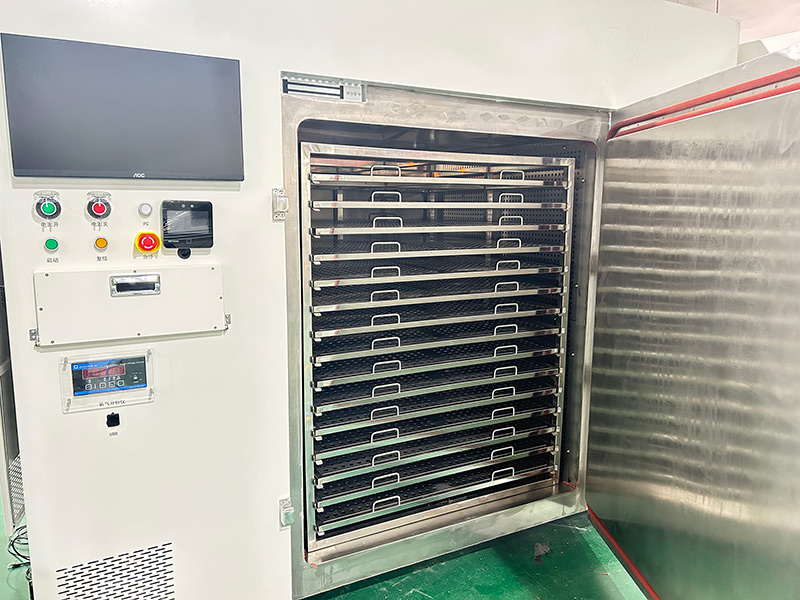
The nitrogen source is the premise of reaching the standard concentration. If there is a problem with the source, no matter how standardized the subsequent process is, it cannot meet the requirements. Common problems include:
Unqualified nitrogen purity: Industrial vacuum nitrogen-filled ovens require nitrogen purity ≥ 99.99% (some high-precision industries require 99.999%). The use of low-purity nitrogen or nitrogen mixed with impurities directly leads to insufficient concentration;
Failure of gas supply equipment: Clogged filter element, invalid molecular sieve of nitrogen generator, or too low residual pressure of nitrogen cylinder (unstable gas supply when lower than 0.2MPa) leads to decreased purity and flow of output nitrogen;
Leakage of gas supply pipeline: Poor sealing of nitrogen pipeline, pressure reducing valve, joint, valve and other parts leads to nitrogen loss, and external air infiltrates at the same time, diluting the nitrogen concentration.
The vacuum nitrogen-filled oven needs to maintain a closed environment to keep the nitrogen atmosphere stable. Seal failure will lead to continuous infiltration of air and dilution of nitrogen. Common leakage points include:
Aging and damage of door seal: After long-term use, the door seal of the oven becomes hard, deformed, cracked and worn, losing its sealing performance, which is the most likely leakage point;
Poor sealing of the box: The seals at the box weld, sampling port, and the connection between the sight glass and the box are aged, or the screws are loose, leading to air leakage;
Decreased sealing of auxiliary system: Wear of vacuum pump seals and poor sealing of pneumatic valves lead to incomplete vacuum pumping, and air infiltrates into the box from these parts at the same time.
Even if the nitrogen source and equipment seal are normal, improper setting of process parameters will lead to incomplete nitrogen replacement and failure to reach the standard concentration. Common problems:
Unreasonable nitrogen filling parameters: Too low setting of nitrogen filling flow and pressure makes it impossible for nitrogen to fill the box quickly; Too high flow leads to nitrogen waste and failure to form a stable atmosphere;
Insufficient replacement cycles: Insufficient number of "vacuum pumping + nitrogen filling" cycles (usually 2-3 times) leads to incomplete discharge of residual oxygen inside the box, which mixes with nitrogen and causes concentration drop;
Insufficient pressure holding/replacement time: Too short pressure holding time after nitrogen filling, or insufficient residence time during replacement, leads to insufficient diffusion of nitrogen and excessive residual oxygen content.
If the reading of the monitoring equipment is distorted, it will lead to misjudgment of nitrogen concentration and even miss real faults. Common problems:
Uncalibrated sensor: The nitrogen concentration sensor has not been calibrated regularly (it is recommended to calibrate once a month) after long-term use, resulting in excessive reading deviation, showing that the concentration meets the standard but is actually insufficient;
Failure of monitoring instrument: Damage to oxygen analyzer, nitrogen concentration display instrument, or poor line contact leads to abnormal display, which cannot accurately reflect the nitrogen concentration inside the box.
Troubleshoot in the order of "from simple to complex, from source to end" to avoid repeated maintenance. Each step is matched with specific solutions, which can be completed by ordinary operators without professional maintenance teams.
Confirm nitrogen purity: Check the output purity test report of the nitrogen generator or the cylinder label to ensure the purity ≥ 99.99%; If the purity is not up to standard, replace the high-purity nitrogen cylinder or overhaul the nitrogen generator (replace the filter element and molecular sieve);
Check gas supply stability: When the nitrogen generator is running, observe the pressure gauge display to ensure that the output pressure is stable at 0.3-0.5MPa; For cylinder gas supply, check the residual pressure and replace the cylinder in time when it is lower than 0.2MPa;
Troubleshoot pipeline leakage: Turn off the nitrogen source, open the pressure reducing valve, apply leak detection fluid (or use a gas detector) on the pipeline, joints, valves and other parts. If bubbles appear (or the detector alarms), it indicates leakage. Tighten the joints, replace the damaged valves, or reseal the pipeline interfaces.
Vacuum pressure holding test (quickly judge whether there is leakage): Close the oven door, start the vacuum pump, pump vacuum to the target value required by the process (usually -0.08~-0.1MPa), turn off the vacuum pump, and keep it for 30 minutes; If the vacuum degree drops by more than 5Pa, it indicates that the box has leakage;
Accurately locate the leakage point: Focus on checking the door seal. If it is aged or damaged, directly replace it with a seal of the same model; Check the box weld, sampling port and sight glass, tighten the loose screws, and replace the aged gaskets; Check the vacuum pump and pneumatic valve, replace the worn seals, and replace the valve in time if it is damaged;
Re-inspection after repair: After replacing the seals and repairing the leakage points, perform the vacuum pressure holding test again to ensure that the vacuum degree drops by no more than 5Pa within 30 minutes and the seal is qualified.
Adjust nitrogen filling parameters: According to the oven volume and material characteristics, reasonably set the nitrogen filling flow (usually 0.5-2m³/h) and pressure (0.3-0.5MPa) to avoid too high or too low flow;
Improve replacement cycles: Strictly implement the "vacuum pumping + nitrogen filling" cycle. 2-3 cycles are required for conventional materials, and 3-4 cycles can be increased for high-precision and oxidation-prone materials to ensure that the residual oxygen content inside the box is ≤ 0.5%;
Extend pressure holding/replacement time: After nitrogen filling, set the pressure holding time to 10-15 minutes. During the replacement process, stay for 5-8 minutes after each nitrogen filling to ensure full diffusion of nitrogen and dilution of residual oxygen.
Sensor calibration: Use third-party standard gas (nitrogen with known purity) to compare the reading of the built-in nitrogen concentration sensor of the oven. If the deviation exceeds ±0.5%, calibrate the sensor in time or replace it with a new one;
Instrument overhaul: Check the oxygen analyzer and nitrogen concentration display instrument, clean the instrument probe, and check the line contact. If the instrument is damaged, repair or replace it in time to ensure that the displayed data is true and effective.
Most faults of insufficient nitrogen concentration can be avoided through regular maintenance. Combined with the use scenarios of industrial ovens and vacuum nitrogen-filled ovens, the following maintenance plan is formulated, which is simple and easy to implement, and reduces the subsequent maintenance cost.
Once a month: Calibrate the nitrogen concentration sensor and oxygen analyzer to ensure accurate readings; Check the sealing of gas supply pipelines, joints and valves, and tighten loose parts in time; Clean the filter element of the nitrogen generator (if any);
Once every six months: Fully check the status of the oven door seal, box seal and vacuum pump seal, and replace those with severe aging in time; Clean the internal filter device and sight glass of the oven; Check the state of the molecular sieve of the nitrogen generator, and replace it if necessary;
Once a year: Replace vulnerable parts such as door seals and vacuum pump seals; Fully detect the air tightness of the box, and weld the leaking parts of the weld; Check the overall operation status of the nitrogen gas supply system, and replace the aged pipelines and valves; Conduct a comprehensive commissioning of the equipment to ensure stable process parameters.
Always use high-purity nitrogen with purity ≥ 99.99%, and it is strictly prohibited to use low-purity nitrogen instead;
After replacing the nitrogen cylinder, first open the valve to empty the residual air in the pipeline (empty time not less than 30 seconds), and then connect the equipment for gas supply;
Strictly abide by the process operation procedures, do not simplify the "vacuum pumping + nitrogen filling" cycle steps, and do not arbitrarily adjust the nitrogen filling flow, pressure and time;
During the operation of the equipment, regularly observe the nitrogen concentration display and vacuum degree display, and shut down for troubleshooting in time if abnormalities are found to avoid fault expansion.
The stable nitrogen concentration of the vacuum nitrogen-filled oven is the key to ensuring product quality and improving production efficiency in electronic components, food, lithium batteries and other industries. Insufficient nitrogen concentration is not a difficult fault. The core is to find the root cause - step-by-step troubleshooting from four dimensions: nitrogen source, equipment seal, process setting and monitoring system, and the problem can be solved quickly.
Enterprises only need to select reliable industrial ovens and vacuum nitrogen-filled oven equipment, strictly implement the nitrogen protection process, and implement the regular maintenance and calibration plan, so as to effectively avoid material oxidation and production losses caused by insufficient nitrogen concentration, and ensure process repeatability and product consistency.
If the problem still cannot be solved after the above troubleshooting, or if equipment selection, process optimization and professional maintenance support are needed, you can pay attention to our official website updates or contact the professional technical service team to obtain one-on-one solutions.
19 years of focus on research and development as well as production